Air India to launch new branding and ad campaign – “mother’s love” new positioning

(Special to MadMan’s Web)

India’s national airline, Air India, which has long been criticized for its aging fleet and even older flight attendants, has finally got the message. In a press conference yesterday at New Delhi, Air India Chairman Rohit Nandan announced a completely new branding campaign and a radical new positioning for the airline to set it apart from the competition.

“The new campaign will be centred around the concept of “Maa Ka Pyaar” and will position the elderly flight crew as care-givers who treat passengers with motherly love, unlike the new breed of airlines who have only brash crews of inexperienced youngsters.”, explained Nanda. “When you are thousands of feet in the sky, anxious to get through with your flight, wouldn’t you rather have someone like your mother to look after your needs?”, he continued.

The new campaign aims to turn one of Air India’s perceived weaknesses and turn it into a notable strength. For this, Air India has roped in well-known award-winning advertising agency Olives and Marshmallows (O&M) and laid out a budget of Rs. 100 crore for a nationwide rebranding campaign. O&M’s National Creative Director, Arnab Kushti, also present at the conference, was visibly excited when he explained the long-term branding strategy. “India has long had ‘Maa‘ – the mother – as a caring symbol of the Indian family. Your mother looks after you unconditionally, and takes care of your needs. Air India’s flight attendants too deliver this same level of love and affection, and we are going to make sure the rest of the world knows about it.”, he explained.

To synergise operating procedures with their new ad campaign, Air India will make changes in the roles of their flight crew. Flight attendants will be trained to treat passengers just like their children, tucking them into bed on long flights and putting crying babies to sleep. In First Class and Business Class, they will bring you seconds for dinner just like mum, and will also sing lullabies on request. What if customers object to this level of pampering? Nanda retorted, “Would you dare shout or get angry at your own mother? Then?”

Details of the campaign, which will cover not only print and TV, but also online channels and social media, are still being worked out, but unconfirmed sources have reported that actress Reema Lagoo, Bollywood’s go-to person for motherly roles, is being courted for Air India’s TV campaign while actress Rakhi Sawant is being considered for the role of a rude flight attendant of a rival airline.


(Satire, not real news)

Posted in Humour | 11 Comments

Airtel announces new Gold and Platinum support plans for customers

(Special to MadMan’s Web)

Bharti Airtel Ltd., which had already declared its vision as “By 2015 airtel will be the most loved brand, enriching the lives of millions”, today announced an accelerated plan to fulfill that vision in 2013 by launching two new levels of technical support plans for its customers.

Launching the new Gold and Platinum support plans at a press conference today, Sunil Mittal, Chairman, said it was based on extensive analysis of customer feedback over the last year, and aimed at fixing many of the existing complaints.

Customers who opt for the new Gold Plan at an extra Rs. 99 per month (+taxes), can avail of features like:

1) Chances of speaking to a real human within 2 minutes increased from 7% to 50% – Mittal said that Gold customers will face shorter hold times. The previous average time on hold of 10 minutes will be reduced by over 50% and there will now be a 50% chance of speaking to a human in 2 minutes.

2) Exuberant female voice on IVR to be replaced by a normal-sounding person – Mittal discussed the findings of their research showing that customers couldn’t readily identify with a female voice that sounded like a 10 year-old getting a new puppy as a birthday gift when announcing words like “Welcome to Airtel!” The new Gold plan will use a more normal sounding 28 year-old woman instead.

3) Access to special Twitter account and web site status page – A major demand from customers was a status update page on both the Airtel twitter account  that informs customers about problems and outages when they actually happen, instead of the earlier operating procedure where customers would be told things “We experienced an outage two days ago for three hours, and it’s fixed now” on Twitter. The new Twitter account, accessible only to Gold and Platinum customers, will provide real-time status updates to help them plan their work day better around service outages.

The new high-priority Platinum Plan, at an extra Rs. 299 per month (+taxes), has all the features of the Gold Plan, plus even more features for Airtel’s most demanding customers. Some of these are:

1) Chances of speaking to a real human being within 2 minutes increased from 7% to 70% - A 10x fold jump in responsiveness, this plan is designed for those customers who absolutely, positively, need to speak to a tech support representative on the phone and are not content with longer wait times.

2) Airtel jingle on loop replaced - Responding to increased incidents of customer phones being damaged by being flung against the wall, Bharti Airtel commissioned independent research into the matter and found out it was caused by irate customers who were listening to the Airtel jingle on loop while being put on hold. Airtel has swiftly taken action. Mittal said, “We will replace the Airtel jingle with bhajans, prayers from the Quran, or Christian psalms instead, keeping in mind the spiritual side of India.” Mittal was confident this would reduce complaints, “…because you can’t swear at God.”

3) Upgraded Twitter responses – Platinum customers, being the cream of the crop, will no longer get replies from the current Twitter and Facebook bot that responds to all complaints with “Would request you to please mail us at airtelpresence@in.airtel.com” “Instead, a responsive team of real people from Airtel and not an outsourced PR company will now handle their problems and escalate them to the right channels”, said a smiling Mittal, as the crowd burst into spontaneous applause, and geeks attending the conference immediately started tweeting about this.

Mittal concluded by saying that he realized that not everyone would be the right target for these value-added plans that required customers to pay an extra monthly fee. So, in true Steve Jobs style, he saved a final interesting bit.

Mittal announced the launch of the new ”Fuck this, I just want to speak to a human being” option for telephone support. At an extra cost of Rs. 29 per incident, all customers can now press 9 to bypass the numerous options and be connected to a live human being who would be able to help them. The reduced time on hold once connected, however, would only be available to Gold and Platinum customers.

“We have something new for all our customers, depending on their needs and priorities”, said Mittal. “This is what makes us the telecom giant that we are, and in the coming years we will continue to pursue this vision, delivering value to both our customers and shareholders.”


(For the humour-impaired, this post is satire, not news. If you’re a Bharti Airtel lawyer, and hence humour-impaired by definition, satire is protected against defamation claims in court.)

Posted in Humour | 22 Comments

Of new restaurants and restaurant critics

Vikram Doctor points me to an interesting couple of blogs posts, one from a restaurant chef, and the other from a restaurant reviewer.

The first post is by Alex Sanchez, a young chef from the US who’s now cooking at this new restaurant in Colaba. He complains about how restauarant reviewers in India don’t give the place a chance to settle down before reviewing. Mangal Dalal responds in Mumbai Boss making the point that restaurant culture is different here and you better get ready to hit the ground running.

Having been a restaurateur, I agree with points on both sides.

Sanchez is right; no matter how well-trained the staff, how organised the kitchen, handling a full house of customers in a new restaurant is stressful, and it is impossible to get into the flow of things for at least a month. This is why I generally don’t visit new restaurants until a month has passed since opening.

Let me share a personal experience: when I moved Shiok to a new location, my original plan was to open with not only a new look, but also a new menu. As delays hit the setup process, I also figured that things would be slow enough with a new restaurant, and there was no need to aggravate it by changing the menu as well. Despite this, things took the usual 2-3 weeks to run smoothly, and this is for a restaurant with largely the same service staff and entirely the same kitchen staff.

That said, as a paying customer, I firmly agree that if a restaurant is taking a customer’s money, they are entitled to a proper dining experience, especially in a high-end place. When Gautam and I visited Edo, the expensive Japanese restaurant in ITC Gardenia in B’lore, we had an excellent experience, despite the restaurant having been formally open only for a week or so.

My recommended way around this for restauranteurs is to not start with a big bang on day one. Restrict news about the opening to only a few connected people, and let a couple of weeks go by with low-traffic before embarking on a publicity blitz. It gives the staff time to get used to the workflow and settle down. This may not sit well with investors, but it’s the best way.

As for the other question of restaurant reviewers, I agree whole-heartedly that most don’t know their mouths from their asses. If it’s college kids writing most reviews (as Mumbai Boss points out), then they possibly don’t know enough about either restaurant reviewing or food. Every restaurant, even the best of them, can have a bad day, and it’s not fair to assess a restaurant till you’ve dined there a few times. You say you don’t have the resources to do that? Well, don’t do restaurant reviews then. You say there are too many new restaurants? Well, don’t review every last one of them. And if a critic is knowledgeable enough, he/she can surely make a judgement call on whether a screw-up is due to general incompetence of the staff or just them having a bad day. The incompetent ones need not be visited again.

Let’s face it, the whole “restaurant review” business in this country is fucked up. The “reviews” for most major newspapers are arranged by PR people, and the critic will happily turn up after informing you in advance. You will make small talk with them, make sure your best waiter is at their service, and the head chef himself handles the food for their table. If you’re a Page 3 person who has been added to the restaurant management for your celebrity value, you will schmooze with them too – so, essentially, nothing like a typical guest’s experience. They will then partake of your free food and booze, and hopefully give you a stunning review. They may even write wonderful things about food they never tasted (a newspaper critic wrote about my fragrant Beef Rendang despite not trying it, and only reading its description in my menu.)

Restaurant “awards” from major publications too are usually a matter of who has more publicity clout or is a major advertiser, and I have often gone, “you can’t be fucking serious!” after seeing a particular restaurant win a category award.

Unfortunately, the average Joe is heavily swayed by such reviews and believes them to be authoritative. And that is the real tragedy of it.

(A post about the uselessness of “user/community reviews” web sites will have to wait for another day. That much vitriol in one blog post may be too much to handle.)

Posted in Food & Cooking, Society & culture, Writing & media criticism | 11 Comments

How not to design a flyover

The problems with Bangalore’s infrastructure are well-known. Everybody knows
we have pathetic pot-holed roads, more traffic than the roads can handle, and an
administration that talks through the wrong orifice about fixing things. Heck,
we can boast that we are possibly the only city in the country, and perhaps the
world, that has a traffic light on a flyover, thanks to the wonderful
administration’s short-sightedness.

But apart from the "oh my gawd, we didn’t foresee the hordes of people
moving in" excuse, there are certain problems with the way infrastructure,
is  designed, that makes you wonder if we might indeed have better luck
entrusting the planning work to a large group of chimpanzees, banging away at
AutoCAD. For instance, at some places, you will find bus stops right after a
traffic light. At others, you will find them around corners. This doesn’t need
some genius-level IQ to figure out, for cryin’ out loud. Who in their right
minds can’t see that erecting a bus stop right after a damn traffic light
is a sure way to cause a traffic block? Couldn’t they move it, say, 200 metres
ahead?

Another thing that the planners don’t seem to understand is the concept of a
"bottleneck". You simply have to look at Old Madras Road, where the 4
lane road is being widened to 8 lanes. Oh, that’s a good thing, you think.
Except that it’s being widened only up to the point of a busy intersection, so
all that happens is that the bottleneck shifts to another point instead.

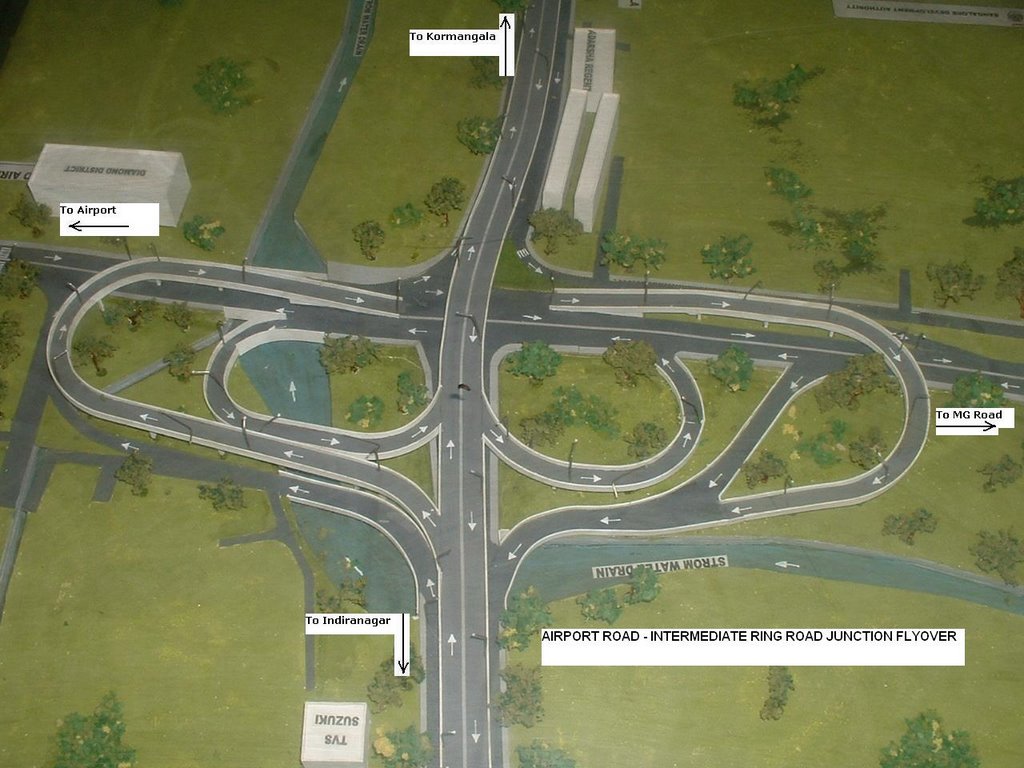
Let me illustrate this in some detail with the example of the Airport Road-Koramangala
flyover
that’s being constructed. This fine piece of work (I almost choked while
writing that) was started in
February 2003 and was supposed to be finished the same year, but of course, all
kinds of bureaucratic problems (methinks somebody didn’t get a big enough share
of the "incidental expenses" pie) led to numerous delays and the first
phase is apparently ready for opening in a fortnight – 3 years later.

The purpose of the flyover is to alleviate the congestion on Airport Road
because the intersection of Koramangala Ring Road, Indiranagar 100 ft Road, and
Airport Road is where three major streams of traffic meet. And anything that can
ease traffic jams is good, right? Flyovers are supposed to help the smooth flow
of vehicles without the problems of having a traffic light, aren’t they? (Unless
you’re using the aforementioned Richmond Road flyover, of course.)

Continue reading

Posted in Society & culture | 21 Comments

New outsourcing opportunity for India

(Special to MadMan’s Web)

Move over call centres and data processing BPOs. The future of outsourcing
belongs to another industry, if Indian Minister for Commerce, Kamal Nath, is to be
believed. According to Nath, the next new wave of growth in the Indian economy
will come from – believe it or not – the protest industry, now being referred to
as SPO – Strong Protest Outsourcing.

Speaking at a news conference in New Delhi, Kamal Nath briefed reporters that
he sees major business opportunities in getting Western countries to outsource
their protests to India. Nath said, "the outsourcing business is about
saving costs and increasing efficiency. Why should people in countries like USA
and UK waste their time protesting over various issues? The per-capita income is
too high to waste time on being offended. Instead, they can simply outsource
this activity to Indian companies." Asked whether Indian companies were
globally competitive in this market, Nath confidently added, "Can you think
of any country better suited for this business? India is a diverse country with
people of many faiths and beliefs. We have a rich history of being offended at
every little thing, from western expressions of love like Valentine’s Day to
what someone names their dogs. I am certain that we can be the dominant player
in this market in the next five years."

After the press conference, Kamal Nath granted MadMan’s Web an exclusive
freewheeling interview in which he talked at length about this new business
opportunity, India’s competence in this area, and the government’s special
initiatives to foster growth in the industry.

MadMan’s Web: Mr. Nath, thank you for giving us this chance to
interview you.

Kamal Nath: My pleasure. This is the Internet age, and blogs are fast
becoming a powerful medium of disseminating information.

MW: Mr. Nath, could you please tell us a little more about this new
opportunity for India?

KN: The world is far from a peaceful place. Every day, there are
protests in Europe and North America over several issues. Part of being
democratic countries is allowing people the right to protest against what they
think is wrong. But protests also waste productivity. When  people are
protesting, they are not contributing to the economy of their nations. So
instead of protesting themselves, they can simply outsource their outrage to
Indian companies that will specialise in this area. They can then go about their
daily lives, confident that their protests are in safe hands.

MW: Why are you so convinced that Indians are the best suited for this
activity?

KN: Of course we are the best! First of all, Indians have been
offended at pretty much everything over the years. If you’ve written a book
that’s even slightly controversial, there are sections that want it banned. If
you make a movie that tackles bold themes, you can expect howls of protest about
how it’s corrupting impressionable young minds. If you wear a female tennis
outfit just like everyone else in the tennis world, somebody will be quick to
point out how you are no longer a good member of your community. So let me
assure you, no matter what the subject of the protest is, we Indians are capable
of delivering a strong protest. Our service standards are world-class and
globally competitive. When it comes to protesting, we are the epitome of "unity in
diversity"! With our wide range of religions, beliefs, and
castes, we are champions at being offended and having our sentiments hurt.

Continue reading

Posted in Humour | 32 Comments